quarta-feira, abril 01, 2015

The Tyranny of the Minimum Viable Product — Medium

The Tyranny of the Minimum Viable Product — Medium

The Tyranny of the Minimum Viable Product

I am the victim of Minimum Viable Product mentality. Minimum Viable Product (MVP) is a product development methodology popular with start-ups to focus a product on the minimum viable feature that will appeal to a customer. Unfortunately, engineering and business culture often focus on minimum features and forgets the viability part. This results in products that are unstable, unusable, and just plain unacceptable.

Much to my wife's dismay, I am an early adopter of a number of Internet of Things products. At last count, I had a dozen separate systems in my house, my car, my body, and even on my dog to track, monitor, and control all kinds of things. The problem is that many of these systems do not work — they are not really viable. I waste huge amounts of time trying to get them installed, connected, and working as advertised. Sometimes I succeed, sometimes I fail. Here are just a few examples:

Smart Home Hub — randomly forgets timers and events, went offline when the network failed.

Smart home hub. I have a popular "smart home" system to control lights, monitor doors, and generally keep an eye on things. A central function of the system is to turn lights on and off at specified times or at events such as sunset and sunrise. The system randomly misses times and events. And, when my network fails, so does the hub.

Fitness Scale — forgot my wifi settings when I changed batteries.

— forFitness scale. I have a bathroom scale that wirelessly ties into my online fitness app. After a year or so, the scale required a change of batteries. When I changed the batteries, the scale "forgot" my wi-fi network settings. I had to spend a frustrating 30 minutes using a variety of computers and mobile devices to get the wifi connection working again.

Internet Thermometer — needs 4 AAA batteries every week

Thermometer batteries. I have a popular internet-connected thermometer with a temperature sensor in the garage. The batteries in the garage sensor need to be changed at least weekly, if not more frequently. Other components have never needed a battery change.

Internet of Things Security Device that trashed my network

IOT Security device. I discovered a device that was all the rage at a recent trade-show. It purports to protect your entire collection of internet of things devices from malware. All of the reviews were glowing, so I purchased and tried to install. The setup seemed really straightforward but, of course, things did not go as depicted in the instructions. I could not get the device to work. When I contacted tech support, there were several additional steps that I needed to take that were nowhere specified in the instructions. When I got it running, it turns out that my TIVOs could not download their program data. Seriously, this device does not work with TIVOs? Aren't TIVOs pretty common? The device company promised that a fix was in the works and would be automatically pushed to my device. A couple of nights ago, a bunch of my lights would not turn off. I got up and diagnosed it and it turned out my network was completely inoperable (thus taking my smart home hub — which controls the lights — offline). When I traced the problem back, it started at precisely the same time as the fix had been pushed to my security device. When I disabled the security device, the network was once again functioning. To top it all off, one of my security cameras died. When I called tech support for the security company, they determined that the camera went offline at precisely the time of the pushed fix. The camera was damaged and had to be replaced.

Why so many product failures? One could speculate that these are all early stage products, built by struggling entrepreneurs on the ragged edge of failure. Possibly. But some of these products are developed or backed by large, well-funded, and experienced companies. I think something else is going on — the tyranny the Minimum Viable Product.

The Minimum Viable Product (MVP) is all the rage in the startup community. The idea is laudable, to focus on core elements of a product that will appeal to early adopters, then build from there as customer needs are uncovered and customers developed. The intent behind the MVP idea is to minimize wasted effort and risk — to focus the product on only the key elements that will capture the imagination of early customers, let them understand the vision and direction, and see the product as an early demonstration of that vision.

The concept is a good one, but its implementation is often flawed because of this unbalanced view:

Minimum Viable Product as Practiced

Deeply embedded in product development culture is the notion of a "feature" — often taken to be an atomic unit of functionality. Development culture (and product management culture, for that matter) seems obsessed with features. We prioritize them, count them, and try to optimize the number of features we implement. But the very notion of a feature is incomplete. It focuses only on what is to be done, not how it is to be done. It screams functionality, and only whispers viability.

The canonic 70s book of philosophical fiction about how to achieve quality

In his 1974 classic of philosophical fiction, Zen and the Art of Motorcycle Maintenance, Robert Pirsig describes two kinds of quality

  1. Classic quality — based on rational analysis, decomposition into parts and their relationships, concerned with details, inner workings, and mechanics.
  2. Romantic quality — understanding the overall gestalt or feel, looking at the whole rather than the parts, relating to context, emotion, and being in the moment.

Although this is a gross over-generalization, engineers and business people tend to be educated to think about classic quality and classic quality is the mental model they apply to their work. Designers and artists tend to live more in the realm of romantic quality and that is the mental model they apply to their work. What we often refer to as the "user experience" is the intersection of classic and romantic quality. If we overweight classic quality at the expense of romantic quality, we end up with a poor user experience.

Mapping these two kinds of quality to the way MVP is practiced shows us that this imbalance is what results in products that don't work as advertised, are overly complicated; don't play well with their contexts, and just outright fail. Developers put too much emphasis on features and functions (classic quality) and not enough emphasis on the whole and its context — i.e. viability (romantic quality).

Minimum Viable Product Meets Zen and the Art of Motorcycle Maintenance

So what is the solution? Obviously, it is to take a more balanced approach — to think about both minimum feature set and product viability in tandem and to give each equal weight.

A more balanced view of MVP

If we did this, we'd be concerned as much about how the whole product "works" in the design sense — meaning that it implements its functions, but does so in a way that the user can understand the functions, they work within their context (i.e. the other devices and system around), and they actually do the job they are intended to do — flawlessly and painlessly.
There has been a lot of attention to design in product development lately. That is good in that it is bringing romantic quality back to product development. Much of it is, however, superficial — it is about the form of the object. We need a deeper design — one that exercises the entire gamut of romantic quality. We need design that balances classic and romantic quality.

Video Doorbell — a minimum viable product that is actually viable

Given limited time and resources, that might mean doing even fewer features. But it will mean doing them exceedingly well. This is possible. I gave a number of examples of failed consumer Internet of Things products above, but one that I recently acquired actually accomplishes this — it is a connected video doorbell. Although it has several "features", it really does only one thing — it is a doorbell with a video camera that can be viewed from a smartphone app. But it does that one thing exceedingly well. The app was easy to use and straightforward. The product was easy to install (including very clear instructions), it connected quickly to my wi-fi network and my existing doorbell, it was visually appealing, and it even included a tool kit that was all that was necessary for installation. It took me about 15 minutes to install and it just worked — the first time — no fuss, no muss. My wife even liked it!

What struck me about this product is that it is probably more minimal than many other products developed under an MVP mindset — yet at the same time it was more functional and more useful than most. By ensuring that it did only one job but did that job exceedingly well, the product is extremely satisfying.

The Minimum Viable Product is a great idea. It focuses teams on what is important. I feel, however, that it has been misused because of too much focus on minimal and too little focus on viable. It is ironic that this is an issue with consumer-based Internet of Things products — after all, the Internet of Things is all about context, connectivity, and networks. The overall gestalt of the networked experience is far more important than each individual thing. Releasing products that aren't viable just begs them to be tried and discarded. App developers for mobile devices know this. They know that an app must be totally usable the first time out, or people will delete it after 10 seconds.

For MVP to truly help develop products that work for the Internet of Things, developers need to focus on romantic quality — viability and user experience as much as or even more than classic quality — features and functions. Bringing viability onto an equal footing with features is what is needed to use the MVP mindset to truly make products people want and love.


Sent from my iPad

How the greatest startup program in Brazil is being killed by politics

How the greatest startup program in Brazil is being killed by politics


It took two years to build the best startup and innovation program Brazil has ever seen, and just a couple of months to kill it.


If you still haven't heard about it, San Pedro Valley is a community of entrepreneurs, universities, accelerators, and investors in the city of Belo Horizonte, state of Minas Gerais, Brazil. Despite of the obvious reference, we're not trying to replicate Silicon Valley in Brazil — we're 200+ restless and hungry founders trying to make it happen in a developing country, and the community name was simply a joke that got traction.

Nevertheless, we must be doing something right. San Pedro Valley, or SPV as we call it, is notoriously the most developed startup ecosystem in Brazil and a key hub in Latin America. This is not our saying: the praise comes fromThe Economist, Forbes and many other respected sources.

While we were impressed with the quality of entrepreneurs and startups in all three cities we visited [São Paulo, Rio de Janeiro and Belo Horizonte], unquestionably, it was in Belo Horizonte that we sensed the highest level of community." Roi Carthy, TechCrunch, May 2012

It was early 2012 when I went to SPV's first happy hour, San Pedro Cerva — "cerva" is a slang for beer. That's where I had the chance to meet an incredible group of people trying to accomplish the very same things I were. I went home amazed, and really excited about it.

A group of SPV entrepreneurs receiving the prize of Best Startup Ecosystem in Brazil, Microsoft's Spark Awards 2014.

Today there are more than 200 startups in the community and some of them are thriving on their markets and becoming leaders in Brazil and Latin America, including Samba Tech, Rock Content, Sympla, Hotmart, Dito andMeliuz — just to name a few. For more information about SPV, there's an article from Anna Heim for The Next Web from december 2011 that is worth reading.


About SEED


Back in the San Pedro Cerva episode, I met this guy called Luiz Filipe Serravite. He was an entrepeneur that had just come back from the Startup Chile program after a couple of months living in Santiago, Chile. He was amazed by the program and the idea of the government actively supporting startups, so he came up with a way to reach the State Governor and proposed the idea of creating something similar in Brazil.

Luiz was involved in the initial development and design of the program. He has eventually left the initiative to go live in the US, but his ideas and initial contacts became the foundation to the program later created and named as SEED (Startups and Entrepreneurship Ecosystem Development).

This description was taken from the official program web site:

Created by the Government of Minas Gerais, SEED is an accelerator program for passionate people who dream big and make things happen.

Entrepreneurs from all around the world descend upon the state, bringing with them in their dreams, experiences, ideas and their determination to build something innovative.

The mission of SEED is simple: Transform Minas Gerais into the most important birthplace and acceleration hub for tech entrepreneurs in Latin America.

The program benefits included up to US$40,000 dollars per team, an incredible office space, mentorship, training, workshops, and a wide network of entrepreneurs, partners and investors. Equity free.

SEED co-working space entrance in Belo Horizonte, Minas Gerais, Brazil.

And the whole thing was really well executed. All the main stakeholders of the ecosystem were involved in its conception, including the entrepreneurs themselves. Government reps, mentors, investors, and entrepreneurs were all working with the same objective: to promote and develop startups and innovation in the country.

I never participated in the program as an accelerated startup, but I had countless chances to engage with it, starting from being a host for a foreign startup — yes, all the foreign teams were hosted by a local entrepreneur so they had a warm reception and felt like they were home. I even picked up a group at the airport the first time they landed in Belo Horizonte.

And of course it was not just me. I would certainly say that all founders living in Belo Horizonte have visited the space at least once. The office was open to anyone, either to host an event or even use a desk/internet connection for a couple of hours or days, no matter if you were an accelerated startup or not.

The SEED space gradually became the obvious place to go in San Pedro Valley. Suddenly we all had a place for meetings, happy hours, meetups, startup weekends and whatever came to our crazy minds. It was great for early-stage startups that didn't have an office yet, but also good for the ones that already had. It was not just about the space — it was a home for the community.

Group of entrepreneurs in front of SEED after one of the many Startup Weekends.

The program was created in 2013 by Governor Antonio Anastasia, through an institution called Escritório de Prioridades Estratégicas de Minas Gerais (or Minas Gerais Strategic Priorities Office). Personally it was one of the first times I have ever been proud of my country/state government. If you have ever heard about politics in Brazil you know corruption and lack of planning is part of our daily news. But these guys were different, they were inspiring and had a truly desire to create something to make a real impact — plus, the program was based on real legislation, and designed to survive government and even party changes.

A lot of people were involved in the conception of the program, but I really need to specially mention André Barrence, Head of the Minas Gerais Strategic Priorities Office and Chairman of SEED, Jaderson Trindade, the Director responsible for the program's operation, as well as Leandro Lacerda, Rejane Martins and Giuliano Bittencourt. These guys did an incredible job and are considered by the community with really special care.

Part of the program board, from left to right: Professor Ivan Moura Campos (UFMG, the Federal University of Minas Gerais), André Barrence (Head of the State Strategic Office), Governor Antonio Anastasia, Gustavo Caetano (Samba Tech), and the Angel Investor Yuri Gitahy.

More than words, the program generated actual results: operating companies, revenue and jobs.


The program was internationally known and considered one of the most important entrepreneurship development initiatives in Brazil.

SEED was responsible for bringing to life 73 companies from 12 different countries that together had R$ 23 million in revenue until the end of 2014, created 145 jobs and raised R$ 10 million from private funds. Plus they influenced the life of 17,000+ people in 55 cities, considering most founders used to mentor and teach kids and young students on low-income communities.


SEED and the government politics


The program was created by the government, so it's really hard not to relate it to politics of any kind… but it's important to notice that it was never mentioned or marketered as an initiative from a specific politician or party — specially when it came to take decisions about the structure, operations or investments.

SEED was initialy led by Governor Anastasia, one of the leaders of the PSDB party (Partido da Social Democracia Brasileira, or Brazilian Social Democracy Party). PSDB governed the state for the past 12 years, since Senator Aécio Neves was first elected in 2003 and then followed by Antonio Anastasia, now also a Senator.

The program began to be questionated and re-evaluated in the beginning of 2015, since the new Governor Fernando Pimentel has been elected. He's part of the PT party (Partido dos Trabalhadores, or Workers Party) — the same party of the re-elected President Dilma Rousseff.

The Secretary of State of Economic Development has denied that the program is in risk to be shut down, and this re-evaluation is part of a broader assessment being done by the new government for all the initiatives and public politics created by the last government.

But that's not really what it looks like. Entrepreneurs were surprised by the fact that the office has been suddenly closed, leaving startups without a place to work — even those who came from outside the country or the state. Plus, the original contacts the SPV community had in the government have been exonerated right before the office.

Photo of SEED's co-working space in Belo Horizonte — byChristophe Trevisani, SPV entrepreneur.

Government says that the closing is temporary, but there are no guarantees that the program will ever come back to life in the same place or the same format. The rental contract of the coworking space itself will be ended by April 1st, and the SEED HQ will not be reinstated there.

Rejane Martins, part of the original SEED staff has posted on the group's official Facebook profile the following statement:

Dear entrepreneurs,

I come to inform you all that, unfortunately, from tomorrow on SEED co-working space will be closed. I'm sorry to let you know on such short notice, but we have been waiting for definitions that by the present moment has not been delivered.

More informations can be taken from Gabriela Costa Xavier, Head of the Secretary of Economic Development, that is also part of this group.

The remaining staff from the original team were also surprised byt the fact that they were let go from their roles in government on Saturday 28th of march. Rejane and the others were informed that the office no longer exists and they will not be incorporated by any other entity within the govern.

Even the program Board members were unaware of the office closing and the future of the program. Yuri Gitahy, one of the most respected angel investors in Brazil and part of our community, has posted a series of tweets in his twitter account saying that he has resigned from his position at the Board, since they were not consulted about any recent program decisions.

Yuri also said it was not a formal resignation, since there's not even an entity or person in charge of the program to inform his decision.

"Today I quit from the board of @SEEDMG. It wasn't a formal act because there isn't even someone in charge to whom I can communicate that."

This article posted today by Estadão, a major newspaper in Brazil, mentioned there might be a dispute between two different government officials for the control of the program, the State Secretariat of Science and Technology of Minas Gerais, Miguel Corrêa (PT) and the State Secretariat for Economic Development, Altamir Rôso (PMDB).

Presently and suddenly, SEED has no funds, no staff and no office.

It's important to notice that the cost of a State Deputy in Brazil — including his salary, massive benefits, budget for 25 cabinet employees — is close to R$ 2M per year. This is pretty close to the cost to of accelerating a batch of 40 startups in the program. Got it? The cost of one Deputy could fund and host an entire SEED batch for six months.

It gets worse. Earlier this year, the government has approved a 40% salary/benefits raise for deputies — obviously, they think it's better to make politicians even richer than investing a tiny fraction of that budget in innovation, i.e. two yearly SEED batches.

From the outside, what we see is a clear party dispute where people discard a huge amount of effort/cash/work so they won't keep initiatives created by the previous administration. They just can't admit that other parties or politicians did a good job. It's not a matter of doing what's good for the country and for the people, but to make sure you can get the proper visibility and political advantages from a perfect program already approved by society — just kill it and rebuild as "yours".

In the end of the day, the country loses.


San Pedro Valley remains strong with or without government support


Many entrepreneurs have manifested their reactions to SEED's HQ closing. The general consensus is that we will do everything we can to keep the program legacy alive.

San Pedro Valley existed long before SEED, and will keep existing after it's gone — welcoming new friends made through this wonderful program.

Our community will remain strong and promoting entrepreneurship — apart from politics. Our beliefs are solid, and we will keep developing entrepreneurs for the future of Brazil.


This article was reviewed by several SPV entrepreneurs. Special thanks to Yuri Gitahy, Luiz Serravite, Matt Montenegro, Pedro Filizzola, Diego Gomes, Roberta Vasconcellos, José de Menezes, Leonardo Conegundes, Mateus Lana, Gustavo Caetano, Bruno Grossi, Christophe Trevisani and André Fonseca.


sábado, fevereiro 21, 2015

Two Ways PG&E Community Solar Gardens Enable 100 Percent Solar for All

Two Ways PG&E Community Solar Gardens Enable 100 Percent Solar for All

Two Ways PG&E Community Solar Gardens Enable 100 Percent Solar for All

California, USA -- PG&E already has enough renewable energy contracts in its portfolio that its customers now get a quarter of their electricity from sources like solar and wind. (Large hydro is not included.)

Now California regulators allow PG&E to enable customers to go 100 percent solar. The passage of SB43 gave all state residents the option to potentially buy power from a nearby community solar garden, creating a new avenue for every Californian could go solar regardless of home ownership, credit rating or roof suitability.

The other big utilities in California have not yet offered this program, but PG&E has now received regulatory approval to offer its customers this option for a few cents more per kilowatt hour added to their utility bill.

The smallest of these community solar gardens would be somewhat larger than this 307 kW array on Alcatraz Island in the San Francisco Bay. Credit: NREL

By the end of 2015, these customers could opt to get up to 100 percent of their electricity from local solar projects in two ways.

People could sign up directly with a solar developer and receive a bill credit from each utility.

"Under this option, customers will be able to contract directly with a third-party developer for a share of the output of a local solar project,"  explained PG&E spokesman, Jonathan Marshall. Aspects of this option are still being worked out by state regulators.

The second way would be to simply sign up through PG&E, and the utility would then contract with solar developers to build projects in nearby infill spaces. 

How PG&E's Green Power Option Would Work

While more solar-savvy customers might be comfortable contracting directly with the solar developer, the utility option may be the easier choice for the average ratepayer, since they'd simply check a box on their PG&E bill to get 50 percent or 100 percent of their electricity from the solar garden.

Unlike its regular utility-scale solar contracts, solar in this 272-MW program wouldn't count towards the utility's 33 percent by 2020 renewable portfolio standard (RPS) requirements, which it has contracted for through 2020.

Either way, solar developers would then build the neighbourhood solar project on nearby open space, industrial building or disturbed lands. Billing would stay with PG&E, making the transition seamless, not involving any particular credit score for a loan to buy solar. 

Currently, leasing or contracting and array for its power production requires a credit score of 650 or more, almost the same needed to borrow from a bank.

"It's a way to enable a lot of customers to participate in solar energy without having to each individually invest in a small relatively costly project," said PG&E program manager Molly Hoyt. "They can in essence be aggregated through the utility and we will go out and get more a more cost-effective sized project and with the power of our procurement resources, which are top notch, so we get the best deal for our customers."

Unlike the green power programs offered by over eight hundred utilities where ratepayers paid some extra for renewable energy credits or landfill-gas recapturing projects they never see, the community solar gardens will be a visible presence locally.

"It is actually quite innovative in that we are buying real steel-in-the ground renewable energy, so it is a very different program from most of the utility green power programs out there," said Hoyt.

Previously Locked Out 

Unlike a home solar contract, customers can opt out at any time, a boon for the commitment-phobic. For those who use few kilowatt hours, and there are many of them in California, the program opens new solar options. 

Low tier users are often the very people that can't go solar themselves. These customers are also often renters in tiny city apartments, or occupy small tree-shaded houses, doubly locking them out of solar savings of the rooftop market. Their PG&E bills are so low that rooftop solar isn't often cheaper, but they could now go solar — albeit by paying a bit extra. 

Interestingly, both Hoyt and Marshall are representative of these customers.

"I use a little over 300 kWh a month," says Marshall. "I am on the lower end of the consumption spectrum; but there are lots of people in coastal California who don't have big air-conditioners and so on. There you're talking $6 to $9 a month."

Goldilocks Size

The size range hits the Goldilocks sweet spot for economy. Community solar gardens, limited to over half a megawatt but under 20 MW, takes much less permitting than utility-scale and is much more efficient to build than a typical 5 kW rooftop solar array.

"Candidly; rooftop solar is a complicated asset. It's a complicated financing and it's a complicated design. It's not like a car where you have one ford 150 truck," as one former solar developer puts it. "Everybody who's getting a solar system is getting something slightly different for each house."

While the smallest might fit on a very large industrial rooftop, most will be ground mounted.

"This kind of mid-sized project size does capture a lot of economies of scale," says Marshall. "It may not be quite as cheap as some of the bigger projects, but I believe it is quite a bit more cost effective than just a small rooftop solar array which is perhaps 5 kW."

For any utility, being able to aggregate solar consumers on neighborhood projects sited near substations or distribution feeders reduces interconnection issues. PG&E is no different.

"We think we are a little bit in the sweet spot," says Hoyt. "You're typically able to use the existing distribution network that already exists while still getting economies of scale compared to a small rooftop system."

Resolving NIMBYism

Siting smaller solar arrays near more solar-friendly urban users also avoids NIMBY permitting obstacles that beset larger utility-scale solar projects sited in rural areas. Marshall points out two much-touted advantages of this mid-size range.

"You could put these on disturbed land that has already been put to use for farming or an old industrial park or something like that so you are not getting into the controversy about untouched desert preserves," said Marshall. "And they will tend to be closer to our distribution lines and thus require less big investment in heavy duty transmission, which also slows things down a lot."

Both regulators and PG&E were committed to ensuring that this cost non-participating customers nothing. To that end, the program has been designed "very carefully," explained Hoyt. "There is a lot of scrutiny by our regulators to that effect."

"We will be segregating and allocating costs very carefully internally so they are allocated only to the program. Nonparticipating customers will not bear any of the costs, and we believe that is a very important principle to adhere to."

Many industry insiders expect solar to be cheaper than natural gas soon. What happens if even smaller utility-scale solar like this costs less than other options in a few years? Would participants benefit?

"[It's] actually is a very real possibility," Hoyt conceded. "So participants in the program in that case will actually be receiving a net credit."


Sent from my iPad

terça-feira, fevereiro 17, 2015

Welcome To The Unicorn Club: Learning From Billion-Dollar Startups | TechCrunch

Welcome To The Unicorn Club: Learning From Billion-Dollar Startups | TechCrunch

Welcome To The Unicorn Club: Learning From Billion-Dollar Startups

Welcome To The Unicorn Club: Learning From Billion-Dollar Startups

Editor's note: Aileen Lee is founder of Cowboy Ventures, a seed-stage fund that backs entrepreneurs reinventing work and personal life through software. Previously, she joined Kleiner Perkins Caufield & Byers in 1999 and was also founding CEO of digital media company RMG Networks, backed by KPCB. Follow her on Twitter @aileenlee

Many entrepreneurs, and the venture investors who back them, seek to build billion-dollar companies.

Why do investors seem to care about "billion dollar exits"? Historically, top venture funds have driven returns from their ownership in just a few companies in a given fund of many companies. Plus, traditional venture funds have grown in size, requiring larger "exits" to deliver acceptable returns. For example – to return just the initial capital of a $400 million venture fund, that might mean needing to own 20 percent of two different $1 billion companies, or 20 percent of a $2 billion company when the company is acquired or goes public.

So, we wondered, as we're a year into our new fund (which doesn't need to back billion-dollar companies to succeed, but hey, we like to learn): how likely is it for a startup to achieve a billion-dollar valuation? Is there anything we can learn from the mega hits of the past decade, like Facebook, LinkedIn and Workday?

To answer these questions, the Cowboy Ventures team built a dataset of U.S.-based tech companies started since January 2003 and most recently valued at $1 billion by private or public markets. We call it our "Learning Project," and it's ongoing.

With big caveats that 1) our data is based on publicly available sources, such as CrunchBase, LinkedIn, and Wikipedia, and 2) it is based on a snapshot in time, which has definite limitations, here is a summary of what we've learned, with more explanation following this list*:

Learnings to date about the "Unicorn Club":

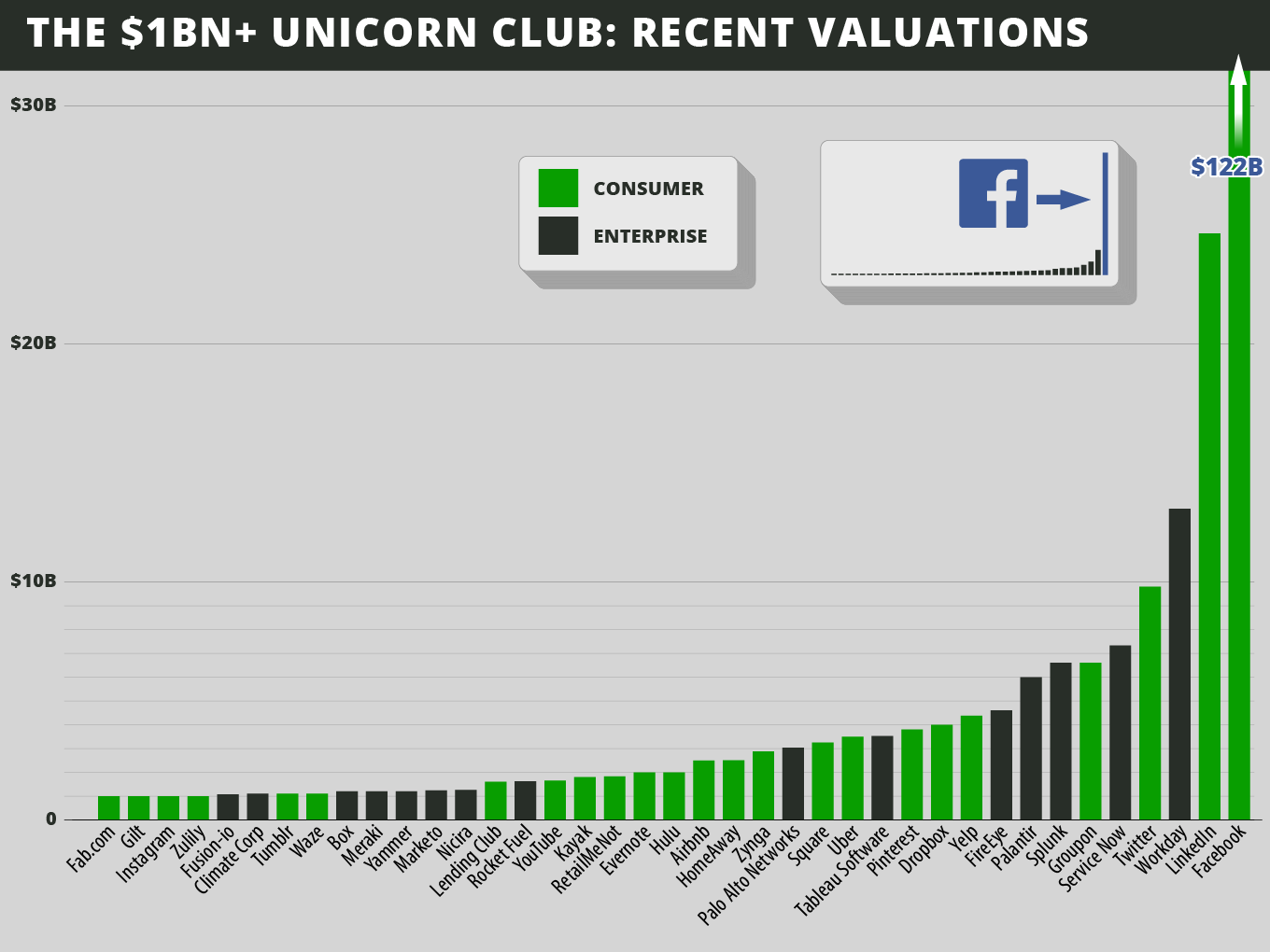
  1. We found 39 companies belong to what we call the "Unicorn Club" (by our definition, U.S.-based software companies started since 2003 and valued at over $1 billion by public or private market investors). That's about .07 percent of venture-backed consumer and enterprise software startups.

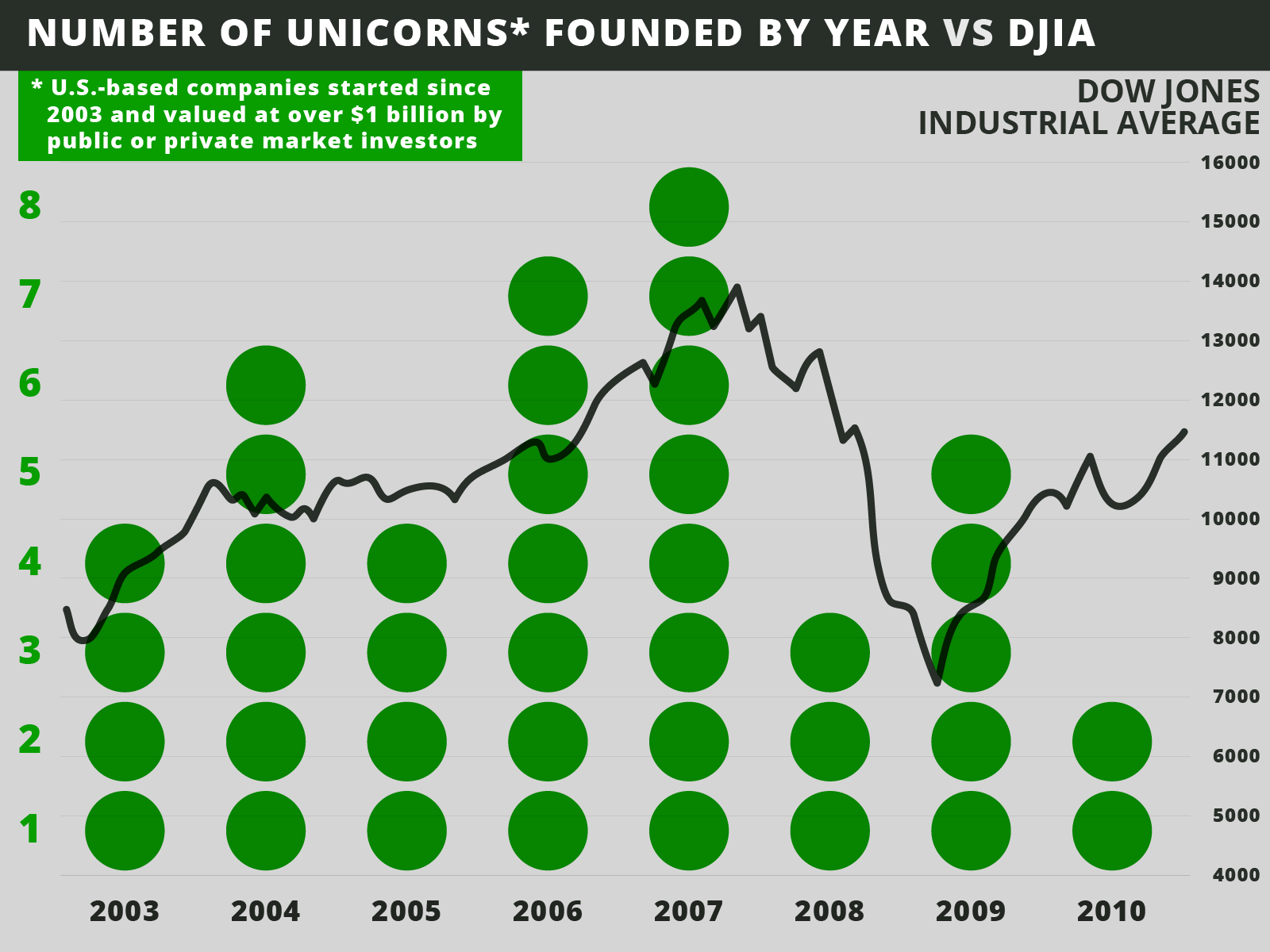
  1. On average, four unicorns were born per year in the past decade, with Facebook being the breakout "super-unicorn" (worth >$100 billion). In each recent decade, 1-3 super unicorns have been born.

  1. Consumer-oriented unicorns have been more plentiful and created more value in aggregate, even excluding Facebook.

  1. But enterprise-oriented unicorns have become worth more on average, and raised much less private capital, delivering a higher return on private investment.

  1. Companies fall somewhat evenly into four major business models: consumer e-commerce, consumer audience, software-as-a-service, and enterprise software.

  1. It has taken seven-plus years on average before a "liquidity event" for companies, not including the third of our list that is still private. It's a long journey beyond vesting periods.

  1. Inexperienced, twentysomething founders were an outlier. Companies with well-educated, thirtysomething co-founders who have history together have built the most successes

  1. The "big pivot" after starting with a different initial product is an outlier.

  1. San Francisco (not the Valley) now reigns as the home of unicorns.

  1. There is very little diversity among founders in the Unicorn Club.

Some deeper explanation and additional findings:

1) Welcome to the exclusive, 39-member Unicorn Club: the Top .07%

  • Figuring out the denominator to unicorn probability is hard. The NVCA says over 16,000 internet-related companies were funded since 2003; Mattermark says 12,291 in the past 2 years; and the CVR says 10-15,000 software companies are seeded each year. So let's say 60,000 software and internet companies were funded in the past decade. That would mean .07 percent have become unicorns. Or, 1 in every 1,538.

  • Takeaway: it's really hard, and highly unlikely, to build or invest in a billion dollar company. The tech news may make it seem like there's a winner being born every minute — but the reality is, the odds are somewhere between catching a foul ball at an MLB game and being struck by lightning in one's lifetime. Or, more than 100x harder than getting into Stanford.

  • That said, these 39 companies have shown it's possible  – and they do offer a lot that can be learned from.

unicorn-graph1

2) Facebook is the super-unicorn of the decade (by our definition, worth >$100B). Every major technology wave has given birth to one or more super-unicorns

  • Facebook is what we call a super-unicorn: it accounts for almost half of the $260 billion aggregate value of the companies on our list. (As such, we excluded them from analysis related to valuations or capital raised)

  • Prior decades have also given birth to tech super-unicorns. The 1990s gave birth to Google, currently worth nearly 3x Facebook; and Amazon, worth ~ $160 billion. The 1980's: Cisco. The 1970s: Apple (currently the most valuable company in the world), Oracle, and Microsoft; and Intel was founded in the 1960s.

  • What do super-unicorns have in common? The 1960s marked the era of the semiconductor; the 1970s, the birth of the personal computer; the 1980s, a new networked world; the 1990s, the dawn of the modern Internet; and in the 2000s, new social networks were built.

  • Each major wave of technology innovation has given rise to one or more super-unicorns — companies that could change your life to work at or invest in, if you're not lucky/genius enough to be a co-founder. This leads to more questions. What is the fundamental technology change of the next decade (mobile?); and will a new super-unicorn or two be born as a result?

Only four unicorns are born per year on average. But not all years have been as fertile:

  • The 38 companies on our list outside of Facebook are worth about $3.6 billion on average. This might feel like a letdown after reading about super-unicorns, but remember, startups generally start as ideas that most people think are crazy, dumb, or not that important (remember when people ridiculed Twitter as the place to share that you were eating a ham sandwich?). Only after many years and extraordinary good fortune, a few grow into unicorns, which is extremely rare and pretty awesome.

  • Unicorn founding was not front-end-loaded in the past decade. The best year was 2007 (8 of 36); the fewest were born in 2003, 2005 and 2008 (as far as we know today; there are none yet founded in 2011 to today). From this snapshot in time, it's not clear whether the number of unicorns per year is changing over time.

  • It would be interesting to plot the trajectory of unicorns over time  — which become more valuable and which fall off the list — and to understand the list of potential unicorns-in-waiting, currently valued at <$1 billion. Hopefully for a future post.

unicorn-graph2

3) Consumer-oriented companies have created the majority of value in the past decade

Venture investing into early-stage consumer tech companies has cooled significantly in the past year. But it's worth realizing that:

  • Three consumer companies — Facebook, Google and Amazon — have been the super-unicorns of the past two decades.

  • There are more consumer-oriented than enterprise unicorns, and they have generated more than 60 percent of the aggregate value on our list outside of Facebook.

  • Our list likely seriously underestimates the value of consumer tech. Of the 14 still-private companies on our list, 85 percent are consumer-oriented (e.g. Twitter, Pinterest, Zulily). They should see a significant step up in value if/when a liquidity event occurs, increasing the aggregate value of the consumer unicorns.

4) Enterprise-oriented unicorns have delivered more value per private dollar invested

  • One reason why enterprise ventures seem so attractive right now: the average enterprise-oriented unicorn on our list raised on average $138 million in the private markets – and they are currently worth 26x their private capital raised to date.

  • The companies that seriously improved this metric are Nicira, Splunk and Tableau, who all raised <$50 million in private markets and are worth $3.8 billion today on average.

  • Plus Workday, ServiceNow and FireEye who are currently worth >60x the private capital raised. Wow.

  • Contrary to conventional VC wisdom about enterprise companies requiring more early-stage capital, we didn't see a difference in Series A dollars raised by enterprise versus consumer unicorns.

Consumer companies have delivered less value per private dollar invested

  • The consumer unicorns have raised $348 million on average, ~2.5x more private capital than enterprise unicorns; and they are worth about 11x the private capital raised.

  • Companies who raised lots of private money relative to their most recent valuation are Fab, Gilt Groupe, Groupon, HomeAway and Zynga.

  • It may just take more capital to build a super successful consumer tech company in a "get big fast" world; and/or, founders and investors are guilty of over-capitalizing consumer Internet companies at too-high valuations in the past decade, driving lower returns for consumer tech investors.

5) Four primary business models drive the value and network effects help

  • We categorized companies into four business models, which share fairly equally in driving value in aggregate: 1) E-commerce: the consumer pays for goods or services (11 companies); 2) Audience: free for consumers, monetization through ads or leads (11 companies); 3) SaaS: Users pay (often via a "freemium" model) for cloud-based software (7 companies); and 4) Enterprise: Companies pay for larger scale software (10 companies).

  • None of the e-commerce companies on our list hold physical inventory as a key part of their business models. Despite that, e-commerce companies raised the most private dollars on average — delivering the lowest valuations vs capital raised, and likely driving the recent cool down in e-commerce investing.

  • Only four of the 38 companies are mobile-first. Not surprising, the iPhone was only launched in 2007 and the first Android device in 2008.

  • Another characteristic almost half of the companies on our list share: network effects. Network effects in the social age can help companies scale users dramatically, seriously reducing capital requirements (YouTube and Instagram) and/or increasing valuations quickly (Facebook).

6) It's a marathon, not a sprint: it takes 7+ years to get to a "liquidity event"

  • It took seven years on average for 24 companies on our list to go public or be acquired, excluding extreme outliers YouTube and Instagram, both of which were acquired for over $1 billion in about two years since founding.

  • 14 of the companies on our list are still private, which will increase the average time to liquidity to eight-plus years.

  • Not surprisingly, enterprise companies tend to take about a year longer to see a liquidity event than consumer companies

  • Of the nine companies that have been acquired, the average valuation was $1.3 billion; likely a valuation sweet spot for acquirers to take them off the market before they become less affordable

7) The twentysomething inexperienced founder is an outlier, not the norm

  • The companies on our list were generally not founded by inexperienced, first-time entrepreneurs. The average age on our list of founders at founding is 34. Yes, the founders of Facebook were on average 20 when it was founded; but the founders of LinkedIn, the second-most valuable company on our list, were 36 on average; and the founders of Workday, the third-most valuable, were 52 years old on average.

  • Audience-driven companies like Facebook, Twitter and Tumblr have the youngest founders, with an average age at founding of 30 (seemingly imminent unicorn Snapchat will lower this average). SaaS and e-commerce founders averaged aged 35 and 36; enterprise software founders were 38 on average at founding.

Co-founders with years of history together have driven the most successes

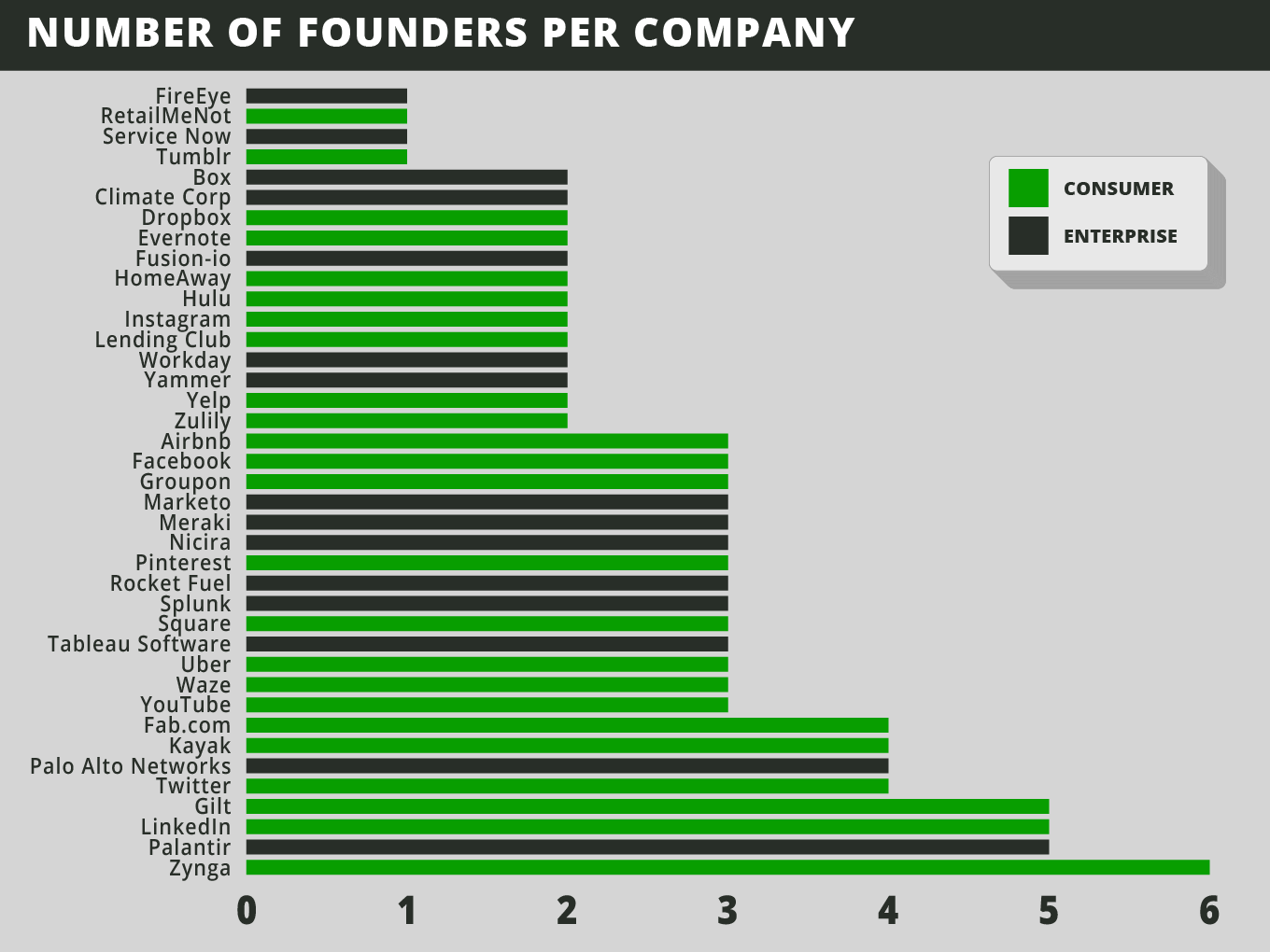
  • A supermajority (35) of the unicorns on our list have chosen to blaze trails with more than one founder — with three co-founders on average. The role of co-founders varies from Co-CEOs (Workday) to technical co-founders who live in a different country (Fab.com). Looking at co-founder equity stakes at liquidity might be another interesting way to look at founder status, which we have not done.

  • Ninety percent of co-founding teams comprise people who have years of history together, either from school or work; 60 percent have co-founders who worked together; and 46 percent who went to school together.

  • Teams that worked together have driven more value per company than those who went to school together.

  • Only four teams of co-founders didn't have common work or school experience, but all had a common thread. Two were known and introduced by the investors at founding/funding; one team was friends in the local tech scene; and one team met while working on similar ideas.

  • That said, the four unicorns with sole founders (ServiceNow, FireEye, RetailMeNot, Tumblr — half enterprise, half consumer) have all had liquidity events and are worth more on average than companies with co-founders.

unicorn-graph3

Most founding CEOs scale their companies for the long run. But not all founders stay for the whole journey

  • An impressive 76 percent of founding CEOs led their companies to a liquidity event, and 69 percent are still CEO of their company, many as public company CEOs. This says a lot about these founders in terms of their long-term vision, commitment and their capability to scale from almost nothing in terms of money, product, and people, to their current unicorn company status.

  • That said, 31 percent of companies did make a CEO change along the way; and those companies are worth more on average. One reason: about 40 percent of the enterprise companies made a CEO change (versus 25 percent of consumer companies). And all CEO changes prior to a liquidity event were at enterprise companies that added seasoned, "brand-name" leaders to their helms prior to being bought or going public.

  • Only half of the companies on our list show all original founders still working in the company. On average, 2 of 3 co-founders remain.

Not their first rodeo: founders have lots of startup and tech experience

  • Nearly 80 percent of unicorns had at least one co-founder who had previously founded a company of some sort. Some founders showed their entrepreneurial DNA as early as junior high. The list of prior startups co-founded spans failure and success; and from tutoring and bagel delivery companies, to PayPal and Twitter.

  • All but two companies had founders with prior experience working in tech/software; and only three of 38 did not have a technical co-founder on board (HomeAway and RetailMeNot, founded as industry rollups; and Box, founded in college).

  • The majority of founding CEOs, and 90 percent of enterprise CEOs have technical degrees from college.

An educational barbell: many "top 10 school grads" and dropouts

  • The vast majority of all co-founders went to selective universities (e.g. Cornell, Northwestern, University of Illinois).  And more than two-thirds of our list has at least one co-founder who graduated from a "top 10 school."

  • Stanford leads the roster with an impressive one-third of the companies having at least one Stanford grad as a co-founder. Former Harvard students are co-founders in eight of 38 unicorns; Berkeley in five; and MIT grads in four of the 38 companies.

  • Conversely, eight companies had a college dropout as a co-founder. And three out of five of the most valuable companies (Facebook, Twitter and ServiceNow) on our list were or are led by college dropouts, although dropouts with tech-company experience, with the exception of Facebook.

8) The "big pivot" is also an outlier, especially for enterprise companies

  • Few companies are the result of a successful pivot. Nearly 90 percent of companies are working on their original product vision.

  • The four "pivots" after a different initial product were all in consumer companies (Groupon, Instagram, Pinterest and Fab).

9) The Bay Area, especially San Francisco, is home to the vast majority of unicorns

  • Probably not a surprise, but 27 of 39 on our list are based in the Bay Area. What might be a surprise is how much the center of gravity has moved to San Francisco from the Valley: 15 unicorns are headquartered in San Francisco; 11 are on the Peninsula; and one is in the East Bay.

  • New York City has emerged as the No. 2 city for unicorns, home to three. Seattle (2) and Austin (2) are the next most-concentrated cities for unicorns.

10) There is A LOT of opportunity to bring diversity into the founders club

  • Only two companies have female co-founders: Gilt Groupe and Fab, both consumer e-commerce. And no unicorns have female founding CEOs.

  • While there is some ethnic diversity on founding teams, the diversity of founders in the unicorn club is far from the diversity of college grads with relevant technical degrees. Feels like some important records to break.

So, what does this all mean?

For those aspiring to found, work at, or invest in future unicorns, it still means anything is possible. All these companies are technically outliers: they are the top .07 percent. As such, we don't think this provides a unicorn-hunting investor checklist, i.e. 34-year-old male ex-PayPal-ers with Stanford degrees, one who founded a software startup in junior high, where should we sign?

That said, it surprised us how much the unicorn club has in common. In some cases, 90 percent in common, such as enterprise founder/CEOs with technical degrees; companies with 2+ co-founders who worked or went to school together; companies whose founders had prior tech startup experience; and whose founders were in their 30s or older.

It is also good to be reminded that most successful startups take a lot of time and commitment to break out. While vesting periods are usually four years, the most valuable startups will take at least eight years before a "liquidity event," and most founders and CEOs will stay in their companies beyond such an event. Unicorns also tend to raise a lot of capital over time — way beyond the Series A. So these founding teams had the ability to share a compelling company vision over many years and rounds of fundraising, plus scale themselves and recruit teams, despite economic ups and downs.

We tip our hats to these 39 companies that have delighted millions of customers with fantastic products and generated so much value in just 10 years despite a crowded startup environment. They are the lucky/genius few of the Unicorn Club – and we look forward to learning about (and meeting) those who will break into this elite group next.

————-

*  Many thanks to the Cowboy crew who helped with this, including Noah Lichtenstein, Meg He, Lauren Kolodny, Kim Stromberg and Jennifer Gee.

** Our data is based on information in news articles, company websites, CrunchBase, LinkedIn, Wikipedia and public market data. It is also based on a snapshot in time (as of 10/31/13) and current market conditions, which are currently fairly "hot."

*** Yes we know the term "unicorn" is not perfect – unicorns apparently don't exist, and these companies do – but we like the term because to us, it means something extremely rare, and magical

**** By our rough definition, consumer companies = e-commerce + audience business models; enterprise companies = Software as a Service + Enterprise business models

***** Our definition of "top 10 school" is according to US News & World Report.

Illustration: Bryce Durbin


Sent from my iPad

Startups, Late-Stage Valuations, And Bull | TechCrunch

Startups, Late-Stage Valuations, And Bull | TechCrunch

Startups, Late-Stage Valuations, And Bull

Bill Gurley, a general partner at Benchmark, makes news mostly because he says what other venture capitalists will tell you while drunk, but does so while on the record. It's refreshing in a way.

Most recently, Gurley made the point that the tech and investment industries are shoving nine and ten-figure sums of cash into startups while not enjoying a full dig into their financials. In the age of the mega-round, the issue isn't a small one: Gurley thinks that some people are investing from the hip and not from the spreadsheet.

Here's the quote:

"Pay attention," Gurley said. "These companies aren't going through a proper audit process. … We're drifting from high-margin businesses to ever-increasing low-margin businesses in terms of what we're saying are unicorns. Be careful. I don't think it's sustainable if you extrapolate that way."

Placing the low-margin bit aside, the point about vetting companies is disturbing. If huge sums of money are going into companies that are not properly audited, there is more risk in the market than was perhaps understood. And more risk, in this case, doesn't mean more potential reward — it means more un-hedged downside.

I talked with Gurley on the phone for a minute on the auditing point and he noted that some companies are raising massive rounds off of a Power Point deck, and not an S-1. The implication is simple: When you go public, you undergo a financial root canal, exposing your strengths and weaknesses alike. Massaged decks aren't like that. And as the market remains flush with bored capital, it seems perfectly happy to shovel it into the maws of companies that report less than you might want before valuing them north of a billion.

(Before I hand the floor to others, I have to ask: Do any of these companies know how to GAAP their top line? I hear endless talk of run rates, and 18-month-away cash flow breakeven, but desperately little when it comes to material profitability.)

Is Gurley Full Of Shit?

Not really, it seems. I reached out to a number of venture capitalists that I think are not stupid, asking for response to Gurley's point on a lack of auditing of firms receiving late-stage capital in large doses. Here's what they had to say:

Matt Murphy of Kleiner Perkins told me that there are "definitely some rounds that go on where the entrepreneur doesn't want to provide detailed data," but that sort of behavior is a "red flag." Murphy went on to note that if a company wants to work with a firm, "they will ultimately provide" the information. "Firms who invest without it," Murphy concluded, "are playing a dangerous game."

Jason Lemkin of Storm Ventures had some hot words for the current market:

I know many very successful VCs that didn't do a single new investment last year because of valuations. Many. But, those that simply chase returns are doing very little diligence these days. They will get burned. And it's not just VCs. Who does diligence on AngelList? No one. No one."

Josh Felser of Freestyle Capital made a different point, noting that "FOMO has been elevated to a higher status than it used to be and that can't be good long term." FOMO, or the 'fear of missing out' is a general term for being terrified in the face of an opportunity passing you by — what if all the cool kids do it? And if you think that the cool kids are doing it, why aren't you? And all of a sudden, $35 million in at a $1 billion pre-money valuation suddenly seems like a deal.

Ron Heinz of Signal Peak Ventures was blunt:

The 'Unicorn Effect' has permeated Silicon Valley and created lofty valuations that are likely unsustainable over the long-term. While we fully expect sophisticated investors to complete thorough due diligence, enthusiasm for exceptional upside is clearly driving valuations higher in some instances.

Shade.

Aziz Gilani of the Mercury Fund feels similarly:

I generally agree with Bill's warning on valuations. This scenario reminds me of the old maxim: 'You pick the valuation and I'll pick the terms'. Right now, some funds are giving in to founder desires for 'unicorn' raises and valuations in exchange for relatively onerous terms.

I presume that that is a subtweet of Box's last round of private capital.

Continuing, here is Jacob Mullins, formerly of Shasta Ventures, and currently of Exitround, a company that helps unwind failed startups: [Update: Mullins noted to TechCrunch in an email that while his company formerly helped companies in trouble find exits, it now assists companies with 8-figure revenue get their M&A on. My bad.]

Today, with stagnancy in the public markets, we're seeing a large inflow of institutional investors, hedge funds and large private equity with far less experience in VC who are piling money into late stage venture rounds in order to find Alpha. This is increasing the availability of capital and thus increasing valuations and size of fundraises. But these firms often don't understand the true risks in venture, nor do they necessarily care because of their risk tolerance with respect to the capital they are putting at work. They invest on the backs of other big VC names assuming that its a safe bet; but in venture, companies rarely are.

It's a vicious capitalistic cycle, because venture investors love having this deluge of easy capital and skyrocketing valuations because it increases the overall holding value of their portfolios.

Chris Calder of Epic Ventures noted that return is concentrated, and expensive:

I think the quality of diligence is there, but because private equity is illiquid, returns are concentrated in a few companies, and there are only so many opportunities to invest (I.e. illiquidity), people are willing to pay up to get exposure. [And] So validation growth becomes lumpy.

Summing the above, it seems, and I know this will shock some of you, that we are currently sunning in the glow of a general asset bubble inside of technology, the result of which is that many funds are willing to buy not just next year's growth at today's prices, but profits that are a decade hence. When money is that generous, why not take it?

Just keep in mind that the business cycle is just that: A cycle. And according to that one dead physicist, whatever goes up tends to come down a bit. It's like the inverse of rent in San Francisco.

Featured Image: amgun/Shutterstock composite


Sent from my iPad

terça-feira, fevereiro 10, 2015

16 Productivity Tools Useful for Every Entrepreneur

16 Productivity Tools Useful for Every Entrepreneur

16 Productivity Tools Useful for Every Entrepreneur

Productivity is the name of the game for entrepreneurs. The good news is that there are thousands of amazing software applications out there, designed to make your life easier. The bad news is that you don't have time to try thousands of software applications. Which ones are worth your time?

In this post, we'll take a look at 16 software applications that I use almost every day -- and discuss why you should too.

Project management.

1. Asana.

You're a busy person. At times, it all can feel overwhelming. Asana is a cloud-based project management software that helps you keep it together. (Trust me, I've tried them all.) Flexibility is built into Asana's architecture. Each "task", or "subtask", can be associated with a larger "project" and "department." In addition, you can even assign recurring tasks to yourself or team, which makes life so much easier. Stop trying to remember all the things you're supposed to do and let Asana structure your life.

2. Google Docs

Many entrepreneurs already have a Gmail address, but not every 'trep knows about the power of Google Docs. By utilizing Google Docs, you can instantly create shareable documents, spreadsheets and presentations that can be updated by any team member with an Internet connection. Take that "track changes"!

Related: 13 Business Productivity Apps for the Real-World Entrepreneur

Staffing

3. oDesk & Elance

oDesk and Elance (now in the process of merging) are freelance marketplaces, which allow you to quickly identify, engage and hire freelancers from all over the globe. Need a website developer or content writer? Don't hire an employee; instead, work with a freelancer. At last count, there were more than 1 million freelance contractors available via these marketplaces.

4. Outsourcing placement services.

If you do much hiring of freelancers, you've probably considered outsourcing the outsourcing. There are several great services that can help, each with varying business models. For example, Bolton Remote will build your team with vetted, offshore contractors. Another provider, Hubstaff, starts with your project in mind and then matches you with project specialists. Using an outsourcing placement service will save time instead of trying to do the recruiting yourself. These firms typically offer free recruiting and placement services but take a cut of the hourly rate.

Sales & Marketing

5. Google Webmaster Tools.

Everyone knows about Google Analytics, but are you using Google Webmaster Tools? As a marketer, I view Webmaster Tools as one of the most important free tools at my disposal. You want to get found on Google, right? Why not listen to what Google is telling you via Webmaster Tools?

6. Google Adwords Keyword Planner

How are your competitors getting found online? Google Adwords Keyword Planner helps you answer this question. The word "Adwords" may give some 'treps pause, as it sounds like you will have to purchase advertising. Not true. Google has made its Keyword Planner tool available to anyone with a Google account (you must first click through the Adwords entry portal). Use the Adwords Keyword Planner to see what keywords are generating the most search volume in your niche and identify opportunities to capture traffic.

7. WordPress CMS

Sure, all of the hosting companies offer a basic CMS (content management system). But do they offer the flexibility that you need to get found online? Probably not. WordPress is an open-source CMS that you can install, customize and continuously optimize. You will likely need someone with development experience to help with set up, but once the template is installed, you're probably smart enough to publish content without any assistance.

8. Amazon's Self-Publishing Tools (Kindle Direct Publishing, Createspace, ACX)

Always wanted to be an author but not sure where to start? Have you considered self-publishing? Thanks to Amazon, you can. Kindle Direct Publishing allows you to get the word out via e-books, CreateSpace helps you develop a print edition and ACX is the audio publishing division. I've used all three to develop my book.

9. HitTail

Deciding what to blog about can become time consuming. HitTail analyzes the data in your Google Webmaster Tools account and makes recommendations for long-tail words to write about. In addition, HitTail has a network of skilled writers who can create the content for you.

Related: 5 Habits of Productivity App Super Users

10. Copyscape

If you outsource any or all of your content writing, you need to make sure your content is original. Paste content into Copyscape's analyzer tool, and you'll instantly know whether the content is original.

11. MailChimp

Effective email marketing involves more than occasionally blasting out a newsletter. To build an effective email marketing strategy, you need a tool packed with functionality. MailChimp seems to be the best system out there, offering elegant, intuitive newsletter templates, advanced list segmentation features and marketing automation capabilities.

12. Zoho CRM

If you're looking for a free CRM system, Zoho is probably the one for you. Why? It comes down to the integration possibilities. For example, Zoho integrates with JotForm and Unbounce simply by adding your API key. This means that within seconds, web leads will automatically be sent to your CRM. Pretty powerful for being free.

Time Management

13. iPhone Reminders

I formerly had an Android device (even though I have had a MacBook since 2009 - weird, I know). After switching this summer, I quickly realized the power of iPhone "Reminders." Each time a reminder is due, your iPhone buzzes and displays a pop-up. You can snooze it or mark as completed. In addition, you can set up recurring reminders, which are perfect for remembering to mail estimated quarterly tax payments, renewing subscriptions, running payroll and other things you tend to forget.

14. Google Calendar

You may already use Google Calendar, but are you using it wisely? Here's a secret: only put stuff on your Google Calendar that will actually happen at that date and time. Use iPhone Reminders to remember things that are not time-sensitive (down to the hour or minute). Following this strategy will help you stay more sane.

Everything Else

15. WeTransfer

Need to send gigantic files (up to 2gb) quickly? Try WeTransfer.com. You don't even have to create an account. I use it almost every day.

16. Zapier

The average entrepreneur uses dozens of cloud-based software and apps. Zapier connects your online life and helps you build new functionality. The best part about Zapier is that you don't have to be an API wizard to use it.

With the right tools in place, you'll find yourself more productive and efficient.

Related: The 15 Best Productivity Apps for Getting Things Done


Sent from my iPad